Alibaba's HappyHorse 1.0 tops AI video leaderboards in 2026. But does it live up to the hype? We compare it against Seedance 2.0 and Kling 3.0 with real tests.
In April 2026, Alibaba's Advanced Technology and Hardware (ATH) division dropped a bombshell in the AI video generation space: HappyHorse 1.0. Within weeks, it shot to the #1 position on multiple leaderboards, boasting an impressive ELO score of 1,367 for text-to-video and 1,402 for image-to-video generation. But here's the question every creator is asking: Is HappyHorse 1.0 genuinely the best AI video model available, or is the hype machine running ahead of reality?
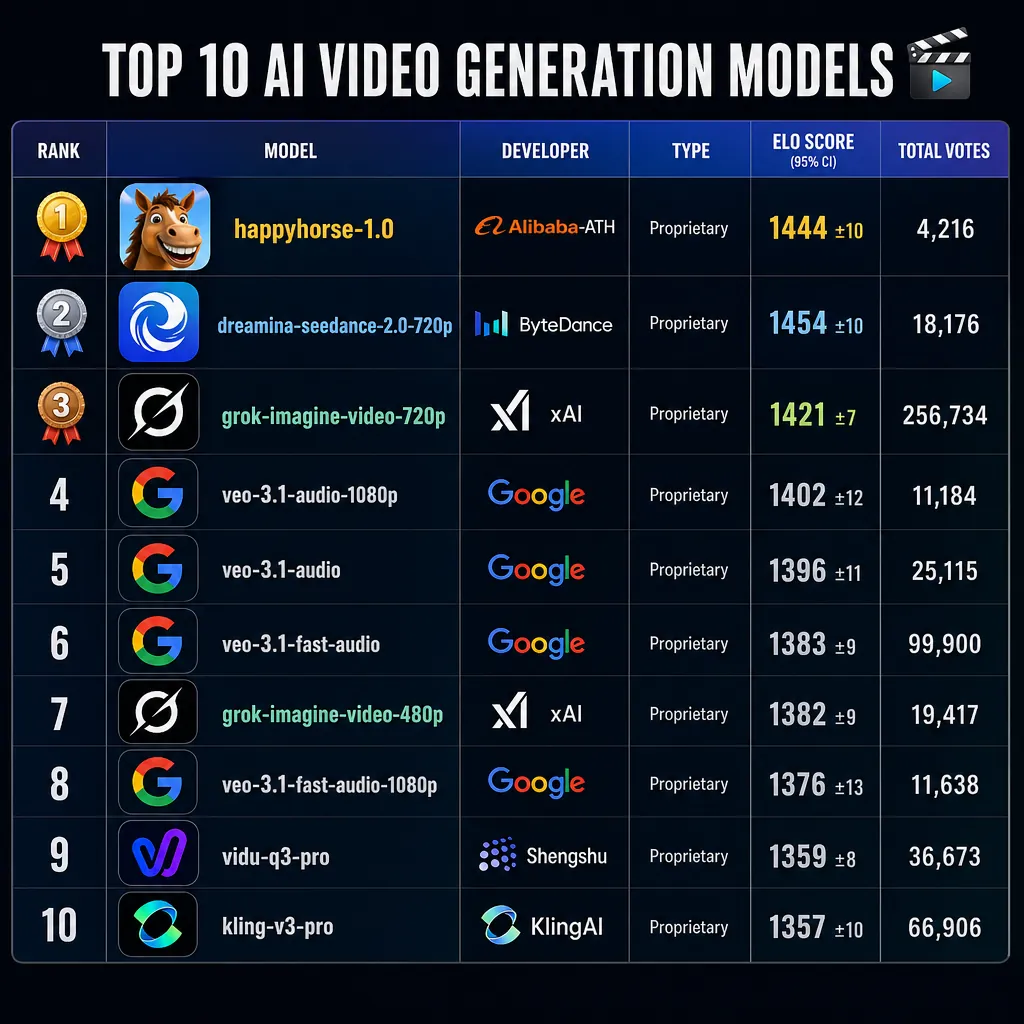
Let's be clear upfront — leaderboard rankings tell only part of the story. While HappyHorse 1.0 has accumulated over 17,000 samples and consistently outperforms competitors in controlled tests, real-world performance reveals a more nuanced picture. After extensive testing with HappyHorse 1.0 text-to-video and HappyHorse 1.0 image-to-video capabilities on JAI Portal, we've found that "best" depends heavily on your specific use case.
Understanding the Leaderboard: What Do Those Numbers Mean?
Before diving into head-to-head comparisons, let's decode what these ELO scores actually measure. The current AI video generation leaderboard uses a rating system similar to chess rankings, where models compete in blind tests evaluated by both human judges and automated metrics.
As of April 2026, the text-to-video leaderboard looks like this:
- HappyHorse 1.0 (Alibaba-ATH): 1,367 ELO — 16,999 samples
- Seedance 2.0 720p (ByteDance): 1,271 ELO — 8,785 samples
- Kling 3.0 1080p Pro (KlingAI): 1,248 ELO — 5,903 samples
- SkyReels V4 (Skywork AI): 1,239 ELO — 6,952 samples
- Kling 3.0 Omni 1080p Pro: 1,233 ELO — 5,329 samples
The image-to-video rankings show HappyHorse with an even more dominant 1,402 ELO score, followed by Seedance 2.0 at 1,346. These numbers suggest clear superiority, but context matters tremendously.
What Makes HappyHorse 1.0 Special?
Alibaba positioned HappyHorse 1.0 as a breakthrough in temporal consistency and motion coherence. The model excels at maintaining character identity across frames, handling complex camera movements, and generating smooth transitions — areas where earlier models often struggled.
Key technical specifications include:
- Maximum video length: 10 seconds at 1080p resolution
- Advanced motion dynamics with reduced morphing artifacts
- Superior text prompt adherence compared to previous generations
- Multi-modal input support (text, image, reference video)
- Enterprise-grade output quality suitable for commercial projects
When you test HappyHorse 1.0 reference-to-video on JAI Portal, the model's ability to match style, motion patterns, and aesthetic from source material is genuinely impressive. It's particularly strong when generating cinematic camera movements like dolly zooms, orbital shots, and smooth tracking.
The Reality Check: Where HappyHorse Falls Short
Now for the uncomfortable truth that leaderboard positions don't always reveal: HappyHorse 1.0 isn't universally superior to its closest competitors, particularly Seedance 2.0 and Kling 3.0.
Physics and Realism: Seedance 2.0's Hidden Advantage
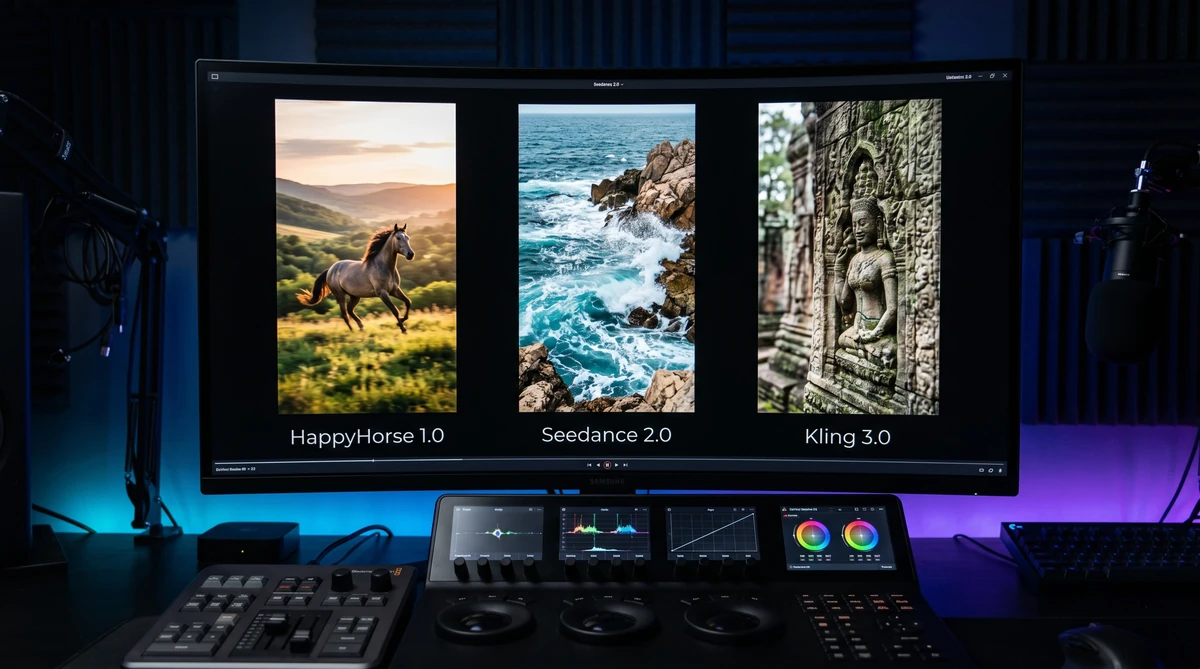
Despite ranking 96 ELO points lower, ByteDance's Seedance 2.0 often produces more physically accurate results. In comparative tests involving water dynamics, cloth simulation, and natural movement, Seedance 2.0 image-to-video consistently delivered more believable physics.
For example, when generating a video of ocean waves crashing against rocks, HappyHorse 1.0 created visually stunning footage with dramatic camera work — but the water's behavior felt slightly "off," with unnatural foam patterns and inconsistent wave timing. The same prompt with Seedance 2.0 reference-to-video produced less cinematic framing but significantly more realistic fluid dynamics.

Scene Transitions: The Cut Quality Controversy
HappyHorse 1.0's marketing heavily emphasizes its "cut" capabilities — the ability to generate videos with scene transitions or perspective changes. While this feature works, it's arguably been oversold. Scene transitions often come with visible artifacts at the cut point, and the model struggles to maintain consistent lighting conditions across cuts.
The HappyHorse 1.0 video editor helps mitigate some of these issues through post-generation refinement, but it's not the seamless solution Alibaba's promotional materials suggested.
Specific Scenarios Where Kling 3.0 Wins
There are several content types where Kling 3.0 Pro image-to-video outperforms HappyHorse 1.0:
- Character close-ups: Kling 3.0 handles facial expressions and micro-movements with greater subtlety
- Product shots: The 4K output from Kling 3.0 4K image-to-video provides superior detail for commercial applications
- Fast-paced action: Kling 3.0's motion blur and frame composition during rapid movement sequences feel more natural
- Architectural visualization: Geometric precision and perspective stability give Kling 3.0 an edge for real estate and construction content
If you're working on projects that require absolute visual fidelity in these areas, Kling 3.0 Standard might serve you better despite the lower ELO score.
Head-to-Head Comparison: Three Top Models
Let's break down how these three leading models stack up across key criteria:
Motion Quality and Temporal Consistency
Winner: HappyHorse 1.0
Alibaba's model genuinely excels here. Character movements remain consistent across frames with minimal morphing, and camera motion feels professionally executed. This is where that #1 leaderboard position makes sense.
Physical Realism and Natural Dynamics
Winner: Seedance 2.0
ByteDance's focus on physics simulation pays dividends. Whether you're generating water, fire, smoke, cloth, or organic movement, the Seedance 2.0 Fast mode delivers more believable results. It's particularly noticeable in nature scenes and anything involving fluid dynamics.
Output Resolution and Detail
Winner: Kling 3.0
The native 4K support gives Kling 3.0 a decisive advantage when pixel-perfect quality matters. While HappyHorse 1.0 produces excellent 1080p footage, the difference becomes apparent when viewing on large displays or when planning significant post-production work.
Prompt Adherence and Creative Control
Winner: HappyHorse 1.0
This is HappyHorse's strongest suit. Complex prompts with multiple elements, specific timing requirements, and detailed camera instructions yield more accurate results compared to competitors. The model rarely "forgets" prompt elements or introduces unwanted creative liberties.
Generation Speed
Winner: Seedance 2.0 (Fast Mode)
For rapid iteration and testing, nothing beats Seedance 2.0's fast generation option. While quality takes a minor hit, you can generate 4-5 test videos in the time HappyHorse 1.0 produces one.
Pricing and Accessibility in 2026
Here's where things get interesting. As of April 2026, HappyHorse 1.0 API pricing is listed as "coming soon," which means Alibaba hasn't fully commercialized the model yet. Meanwhile:
- Kling 3.0 Pro: $13.44 per minute of generated video
- SkyReels V4: $7.20 per minute
- Seedance 2.0: No public API (available through select platforms only)
The good news? All three models are accessible through JAI Portal's video generation suite with straightforward pay-as-you-go pricing. No subscriptions, no complex API integrations — just purchase credits and start creating.
JAI Portal offers 10 free credits on signup (no credit card required), letting you test HappyHorse 1.0, Seedance 2.0, and Kling 3.0 side-by-side before committing to any paid credits. This democratizes access in a way that standalone platform subscriptions never could.
Practical Use Cases: Which Model for What?
After weeks of testing, here's our recommendation framework:
Choose HappyHorse 1.0 When:
- You need complex camera movements with multiple elements
- Temporal consistency is critical (character animations, brand videos)
- Your prompts are highly detailed with specific requirements
- You're creating narrative content where smooth motion matters more than physics accuracy
- You want the "safest" choice that performs well across most scenarios
Choose Seedance 2.0 When:
- Physical realism is paramount (nature documentaries, scientific visualization)
- You're generating content involving water, fire, or complex natural phenomena
- You need rapid iteration and testing (use Fast mode)
- Organic, believable movement trumps cinematic camera work
- Your budget is tight and you can sacrifice some polish for better physics

Choose Kling 3.0 When:
- 4K output is non-negotiable (commercial work, large displays)
- You're creating product demonstrations or architectural walkthroughs
- Facial expressions and character close-ups are central to your video
- You need maximum detail for subsequent VFX work or editing
- Fast-paced action sequences are your primary focus
The Verdict: Context Is King
So, is HappyHorse 1.0 really #1? Yes and no.
The leaderboard rankings reflect genuine strengths in motion quality, prompt adherence, and general-purpose performance. If you need a single "go-to" model for varied projects, HappyHorse 1.0 deserves serious consideration. Its consistent performance across different prompt types and scenarios justifies the top ranking.
However, the gap between HappyHorse 1.0 and its nearest competitors is narrower than the ELO scores suggest. Seedance 2.0's superior physics and Kling 3.0's 4K capabilities aren't reflected in aggregate rankings, but they matter enormously for specific applications.
The real power move in 2026? Using all three models strategically. JAI Portal's pay-as-you-go approach means you're not locked into a single ecosystem. Generate your base video with HappyHorse 1.0 for smooth motion, use Seedance 2.0 for any physics-heavy sequences, and upscale critical shots with Kling 3.0's 4K output. Mix and match based on each scene's requirements.
Final Thoughts: Beyond the Hype
Alibaba deserves credit for pushing the boundaries with HappyHorse 1.0. The model represents genuine advancement in AI video generation, particularly in temporal consistency and prompt fidelity. But the "#1" label comes with caveats that the leaderboard doesn't capture.
For professional creators in 2026, the smartest approach isn't choosing a single "best" model — it's understanding each tool's strengths and weaknesses. Test extensively (remember those 10 free credits on JAI Portal), compare results for your specific content type, and don't let leaderboard rankings override your own creative judgment.
The AI video generation landscape is evolving rapidly. By the time you read this, we might already see HappyHorse 1.1 or a surprise contender taking the crown. What won't change is the need for creators to evaluate tools based on real-world performance, not just ranking systems designed for controlled testing environments.
Frequently Asked Questions
Is HappyHorse 1.0 actually better than Seedance 2.0 and Kling 3.0?
HappyHorse 1.0 ranks higher on leaderboards with better overall motion quality and prompt adherence. However, Seedance 2.0 produces more realistic physics, and Kling 3.0 offers superior 4K detail. The "best" model depends on your specific project requirements. You can compare all three models side-by-side on JAI Portal with pay-as-you-go pricing and see which fits your needs.
How much does HappyHorse 1.0 cost to use in 2026?
Alibaba hasn't released official API pricing yet (listed as "coming soon"). However, you can access HappyHorse 1.0 through JAI Portal's pay-as-you-go credit system with no subscriptions required. New users get 10 free credits on signup without entering a credit card, letting you test the model before purchasing additional credits.
What are HappyHorse 1.0's biggest weaknesses?
Despite the #1 ranking, HappyHorse 1.0 has limitations. Its physics simulations are less realistic than Seedance 2.0, particularly for fluid dynamics and natural phenomena. The scene transition "cut" feature, while functional, produces visible artifacts at cut points. It also maxes out at 1080p, while Kling 3.0 offers native 4K output for applications requiring maximum detail.
Can I use HappyHorse 1.0 videos commercially?
Yes, videos generated with HappyHorse 1.0 on JAI Portal can be used for commercial projects. JAI Portal's terms allow commercial use of all AI-generated content without additional licensing fees, making it suitable for client work, advertising, social media content, and other professional applications.
Which AI video model is best for realistic water and nature scenes?
For nature content requiring accurate physics, Seedance 2.0 consistently outperforms HappyHorse 1.0. ByteDance's model excels at water dynamics, fire simulation, wind effects, and organic movement. If you're creating environmental or documentary-style content where physical realism matters more than cinematic camera work, Seedance 2.0 is your best choice.
How do ELO rankings work for AI video models?
ELO rankings measure AI video models through blind comparative testing where human evaluators and automated systems judge outputs side-by-side. Models gain or lose points based on wins and losses against other models. While ELO scores indicate general quality and consistency, they don't capture specialized strengths like physics realism or resolution capabilities, which is why real-world testing remains essential.
Can I test multiple AI video models before choosing one?
Absolutely. JAI Portal provides access to HappyHorse 1.0, Seedance 2.0, Kling 3.0, and over 500 other AI models through a single platform. With 10 free credits on signup and no subscription requirements, you can generate test videos with different models using identical prompts to compare results directly. This approach is far more effective than relying solely on leaderboard rankings.