🎬
Video Quality and Cinematic Appeal
Kling wins
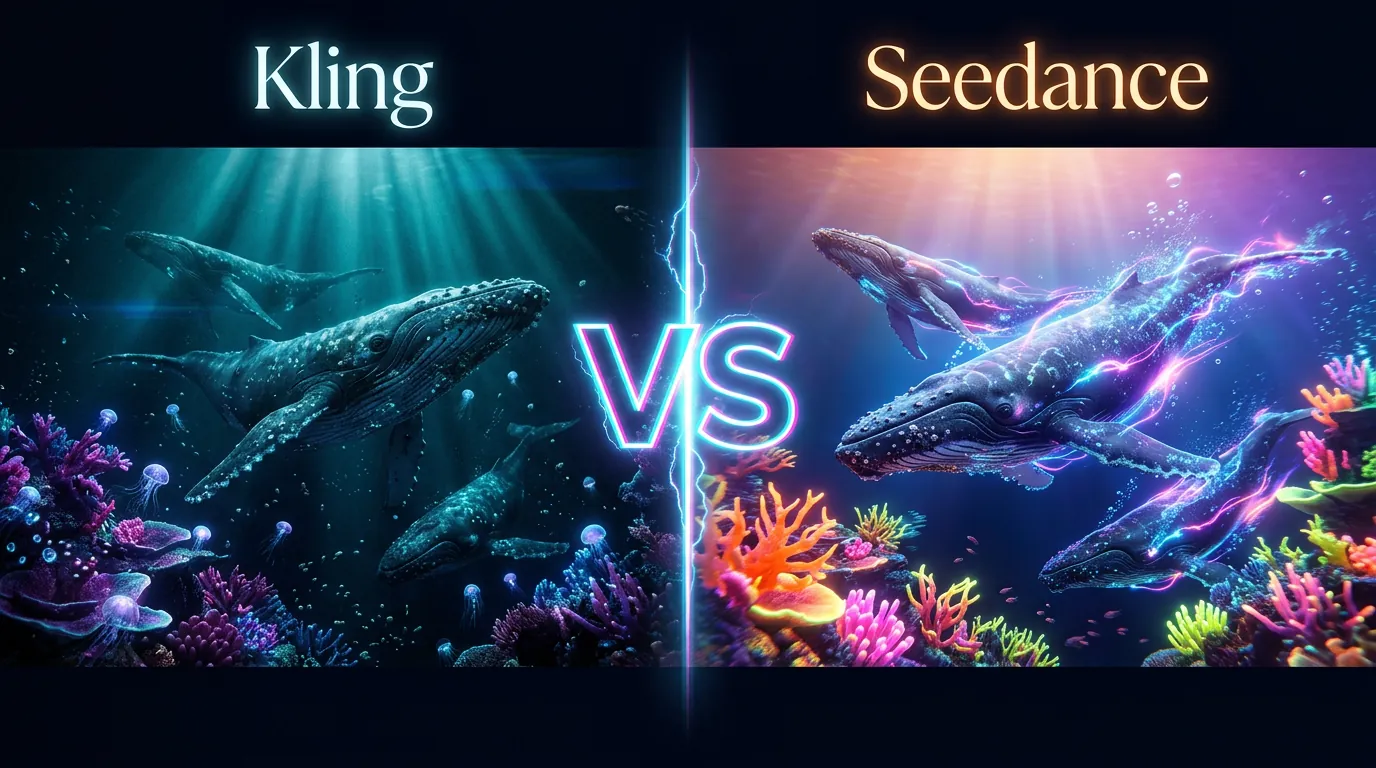
Kling sets the benchmark for cinematic video quality in AI generation. Its output consistently delivers professional-grade aesthetics with exceptional attention to lighting, composition, and visual fidelity. The model excels at creating videos that look like they were shot with high-end cameras, complete with natural depth of field and realistic color grading. Details remain sharp throughout the generation, and the overall polish rivals traditional video production.
Seedance produces high-quality videos that are impressive in their own right, delivering clean, detailed output suitable for most content creation needs. While the quality is strong, it doesn't quite reach the cinematic heights of Kling. The videos have a slightly more digital appearance and may lack some of the subtle nuances that give Kling's output its film-like quality. However, for social media, marketing content, and rapid prototyping, Seedance's quality is more than adequate and often indistinguishable to casual viewers.
For creators prioritizing that extra level of polish and professional presentation, Kling's superior quality justifies its higher cost. The difference becomes most apparent in side-by-side comparisons and when content is viewed on larger screens or in professional contexts.
🎯
Motion Physics and Realism
Kling wins
Motion physics is where Kling truly distinguishes itself from the competition. The model demonstrates an exceptional understanding of real-world physics, producing movements that feel natural and believable. Whether it's the subtle sway of fabric, the realistic bounce of objects, or the fluid motion of human characters, Kling captures the nuances that make video feel authentic. Complex actions like running, dancing, or interactions between multiple elements are handled with remarkable sophistication.
Seedance delivers solid motion physics that work well for most use cases. The model handles basic movements effectively and produces smooth animations for straightforward scenarios. However, in more complex situations involving multiple moving elements or intricate physical interactions, you may notice occasional inconsistencies or less refined dynamics. The motion can sometimes appear slightly floaty or not quite obey real-world physics in the same way Kling does.
The gap in motion quality becomes most evident when generating videos with human subjects performing complex actions or scenes with multiple interacting elements. Kling's advanced physics simulation makes it the clear choice for projects where motion realism is critical.
⚡
Speed and Efficiency
Seedance wins
Seedance takes a commanding lead when it comes to generation speed. With typical processing times of 1-2 minutes for standard videos, it's one of the fastest AI video generators available. This rapid turnaround makes it ideal for iterative workflows where you need to test multiple prompts or variations quickly. The speed advantage is particularly valuable for content creators working under tight deadlines or those who want to experiment extensively without long wait times.
Kling prioritizes quality over speed, with typical generation times ranging from 2-4 minutes depending on complexity and length. While this isn't slow by industry standards, it's noticeably longer than Seedance. The extra processing time reflects the additional computational resources dedicated to achieving superior quality and more sophisticated motion physics. For projects where you're willing to wait a bit longer for better results, this trade-off is worthwhile.
The speed difference becomes significant when you're generating multiple videos or iterating on concepts. Seedance allows for approximately twice as many generations in the same timeframe, which can be crucial for rapid content production workflows or A/B testing different creative approaches.
💳
Pricing and Value
Seedance wins
Pricing is a clear differentiator between these two platforms. Seedance costs 20 credits per generation, making it one of the most cost-effective premium AI video generators available. This lower price point enables creators to generate more content within their budget, experiment freely without financial pressure, and maintain sustainable production costs for ongoing projects. The value proposition is strong, especially considering the quality you receive at this price.
Kling costs 40 credits per generation, exactly double Seedance's price. This premium pricing reflects the superior quality and advanced capabilities the platform offers. For professional projects where the final output quality directly impacts business results, the additional cost is often justified. However, for high-volume content creation or experimental work, the higher price can become a significant factor in platform selection.
Both tools are available on JAI Portal with pay-as-you-go pricing, eliminating subscription commitments. New users receive 10 starter credits to test both models. The choice between them often comes down to whether you prioritize maximum quality (Kling) or cost efficiency and volume (Seedance). For many creators, the optimal approach is using Kling for final, client-facing content and Seedance for drafts and iterations.
🎨
Ease of Use and Workflow
Kling wins
Kling offers an exceptionally intuitive interface that makes professional-quality video generation accessible to users of all skill levels. The prompt interpretation is sophisticated, often understanding creative intent even from relatively simple descriptions. The platform provides helpful guidance without overwhelming users with technical options, striking an excellent balance between simplicity and control. Both text-to-video and image-to-video workflows are streamlined and logical.
Seedance provides a user-friendly experience with multiple model versions (Lite, Pro, Spicy) that cater to different needs. While this flexibility is valuable, it can initially be confusing to determine which version to use for specific projects. The interface is clean and functional, though it may require slightly more experimentation to achieve optimal results compared to Kling. The multiple input options (text-to-video, image-to-video, reference-to-video) offer versatility once you understand the differences.
Both platforms integrate seamlessly into JAI Portal, where you can compare their outputs side-by-side on the same prompts. This unified environment eliminates the need to manage multiple accounts or learn different interfaces, making it easy to leverage the strengths of both tools within a single workflow.
🎯
Use Case Suitability
Tie
Kling excels in scenarios demanding professional presentation and cinematic quality. It's the ideal choice for client presentations, commercial advertising, film pre-visualization, high-end social media content for premium brands, and any project where the video quality directly represents your professional reputation. The superior motion physics make it particularly valuable for videos featuring human subjects, complex actions, or scenarios where realistic movement is critical to the narrative.
Seedance shines in high-volume content creation, rapid prototyping, social media content production, educational videos, internal communications, and projects with tight budgets or timelines. Its speed and cost-effectiveness make it perfect for creators who need to produce multiple videos daily or experiment extensively before finalizing concepts. The quality is more than sufficient for most digital platforms where content is consumed quickly on mobile devices.
Many professional creators adopt a hybrid approach: using Seedance for initial concept development, testing multiple variations, and creating draft versions, then switching to Kling for final production of the best-performing concepts. This strategy maximizes both efficiency and quality while optimizing credit usage across the content creation pipeline.